Debre Zeit evolved over a long period of time. As pointed out, accounts of earlier travelers call the region “Adda”, although one Swedish memoir from 1935 mentions a village named “Bishoftu” . However, “as a definite entity, Debre Zeit did not come into existence until after the Second World War” (source: Debre Zeyit – History (liquisearch.com).
During the Italian brief occupation of Ethiopia, historical records show that “at about 1 kilometer (0.62 mi) from Adda, on land that had been owned partly by Emperor Haile Selassie I, the Italians started Azienda Agraria di Biscioftu dell’Opera Nazionale per i Combattenti (Agricultural company of Bishotu of the National Opera for Fighters) on 15,000 hectares. The intention was “to create a center of colonization as well as an experimental agricultural station.” Hence, “the first foundation stone for the houses was laid on December 9, 1937”. However, “only 21 dwellings were ready by May 1938”. Various administrative and service buildings were also built.
Eventually after the Italians were driven out, the history of Debre Zeit /Bishoftu became tightly woven with the history of the Ethiopian air force and other important establishments.
Historical documents show that ‘in 1946, the beginnings of what would become the Ethiopian Air Force was moved from the Bole airport in Addis Ababa, which was needed by Ethiopian Airlines, to Bishoftu.”
As documented, the move included an initial group of 19 Swedes under Count Carl Gustaf von Rosen, who were there to train the pilots and support personal. They arrived in Debre Zeit after leaving Sweden between 9 January and 16 July 1946. In addition to the Airforce, there has been at least a battalion of Ethiopian Airborne soldiers in Debre Zeit.
Besides the Airforce and Airborne, other significant and influential developments took place that molded Debre Zeit and made it a magical place for the cohorts of the 1970. The first is the establishment of Debre Zeit Agricultural Research Center in 1953 under the then Alemaya Agricultural College, now Harmaya University.
The establishment of the Agricultural Research Center was shortly followed by the founding of An Evangelical College. The Evangelical college attracted students from across the country making Debre Zeit mingling and tolerant place.
Finally, the establishment of the Animal Health Assistants Training School in 1963, with financial support by the United Nations Special Fund was a very welcome addition.
Besides the Airforce and key educational establishments, Debre Zeit was also the favored weekend retreat of Emperor Haile Selassie, who built a palace in the town, named “Fairfield” after his wartime home in exile in the town of Bath, England. This also enhanced the image and preference for Debre Zeit and contributed to its attraction as a resort destination.
Debre Zeit’s unique Cultural Festival:
Lake Hora have been used as cultural festival (Irrechaa) destination for a long time.
In the 1950s and 1960s, when we were growing up in Debre Zeit, Irrechaa was one unique Oromo cultural festival we look forward to go to. Irrechaa is a big festival held every year under a big tree by lake Hora. The festival occurs just as the rain season ends and the fields are field with green grass and yellow flowers (Addie Abeba). Participants of the festival flock to Lake Hora to give thanks to Waka (God), join friends and family to dance and get merry as well as some come to wish for fertility.
Most of the essence of Irrechaa cultural values remained the same over time. However, Irrechaa is now also celebrated in Addis Ababa at Meskil square. This increased the visibility and number of participants of the celebration. A cultural celebrations which was unique to Debre Zeit is now a national celebration.
Debre Zeit Viewed in The Context of 1955 Ethiopia
To have a glimpse of the economic, political, social and cultural context of Ethiopia and Debre Zeit when Dr. Tebabu Tessema Wubetu and his friends were preparing to go to school, a documentary video is presented below entitled “Ethiopia 1955”.
1955 is closest year when Dr. Tebabu Tessema Wubetu and his high school graduating class of the 1969-70 have lived through their early years experience. The intention of showing the documentary is not to advocate for the period, rather simply to show how life might have looked like in that time and place and provide a context. It is hard to underestimate the influence of the environment.
Also, as was seen briefly in the documentary, Debre Zeit in 1955 looks like a modern town, with modern hotel and festive environment. Clearly the place looks opulent.
Schools in Debre Zeit:
Unfortunately, there were only one elementary school and no secondary school for a long time. only a long time after 1955 did Debre Zeit added a model School to serve primarily children of Air force personnel as most of air force officers were living east of the city center where the only elementary school at the time, Atse Lebnedingle school was located.
As the demand for education grew, more schools were built such as model elementary schools and a secondary school around 1967 or 1968. Fast forward three decades later to 1998, the model school built in the 1960s ” is now called Adaa model senior secondary school”. It has a student population of about 4,000 serving in two daily and one evening shifts.
Interestingly, upholding the magic of Debre Zeit that is similar to the 1970 cohorts experience, according to the vice principal of Adaa secondary school, “students achieve an exceptionally high level of success in the state exams.” (Source: yoav ben-dov, an article of a Isralie citizens who visited Debre Zeit in October 1998, debre zeit (bendov.info). This shows the continuation of high level of success well after the 1970 cohort time. The magic of Debre Zeit lives on.
Comparison of population age pyramid
One additional contextual piece to look at to get a better sense of the 1955’s Ethiopia, and by extension Debre Zeit, is to look at the male and female population by five-year age group using population pyramid. This is contrasted with the male and female population pyramid of Ethiopia for 1955 and 2021 to illustrate the changes that transpired over time.
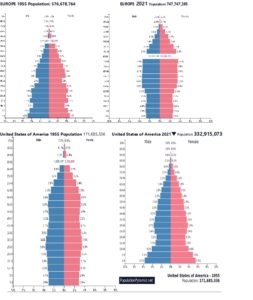
Similarly, to compare continental and international situation, the male and female population of Africa, Europe and United States of America (U.S.A) for 1955 and 2021 is compared to that of Ethiopia. While the age pyramid is close for Ethiopia and Africa, the picture is different for Europe and U.S.A.
Observations about the age pyramid:
1) Population Growth: Population increased in Ethiopia, Africa, Europe and USA between 1955 and 2021. However, the increases are wildly different, with Ethiopia in particular and Africa in general experiencing an explosive population growth.
Table B: Summary of Population changes between 1955 and 2021
Jurisdiction
Year
Population
% Change
Ethiopia
1955
19,947,291
2021
117,876,226
490.9%
Africa
1955
252,748,916
2021
1,373,486,472
443.4%
Europe
1955
576,678,764
2021
747,747,395
29.7%
USA
1955
171,685,336
2021
332,915,073
93.9%
2) Shifting Share of the under 30 years of age: The under 30 years of age segment of the population is the student population as well as a very productive part of the society. Over the last 66 years, two discernable changes occurred:
First, the share of this segment of the population exhibited a wide difference in Ethiopia and Africa on the one hand and Europe and USA on the other side. In Ethiopia and Africa, the under 30 represented more than a third of the population while in Europe and USA, it accounted for only a quarter.
Secondly, the share of this segment of the population shrank in all jurisdictions, although the shrinkage in Ethiopia and Africa was less than half a percentage point (0.4 for male and 0.6 for female) Hence, it is less pronounced in Africa.
On the other hand, the shrinkage of under 30 in Europe was more drastic, experiencing 9.2% and 9.7% drop for males and females respectively. The slightly over 5% decline in the share of both genders in the share of the under 30 in USA was not as drastic as in Europe. Further analysis is required to understand what the implication of this shift is.
Finally, the shrinkage of the under 30 shares of female segment of population is more pronounced than the male in all jurisdictions, although the magnitude is different among the different jurisdictions.
Table c: Summary of changes in the share of under 30 between 1955 and 2021
% Population under 30 years
Percentage point Change between 1955 and 2021
Jurisdiction
Year
Male
Female
Male
Female
Ethiopia
1955
35.4
35.0
2021
35.0
34.4
-0.4
-0.6
Africa
1955
34.3
33.9
2021
33.9
33.2
-0.4
-0.7
Europe
1955
25.6
25.3
2021
16.4
15.6
-9.2
-9.7
USA
1955
25.0
24.5
2021
19.6
18.8
-5.4
-5.7
3) Gender dominance switching age: It is common in all jurisdictions that among the very younger age groups, the share of male exceeds the share of female population (predominantly male). However, at certain age, for many reasons, the share of females starts first to even out and then exceed that of the male population’s share (predominantly female) .
First, to our knowledge, this reversal of dominance is not much discussed much in the literature. Although the many implications of the switch are not well understood, it is important to notice at what age the switch occurs. In terms of the gender switching age, first, there is a wide variation among all the jurisdictions. Second in all cases, the age at which the switch occurred moved up over time.
For instance, in Ethiopia and Africa the age when the age-gender switching occurred is relatively narrow than in Europe and USA. USA experienced the most dramatic change where the share of females exceeding males rose from the age of 20-25 in 1995 to 60-64 in 2021. Changes in Europe is not much different from that of the USA, where the age-gender switching moved up from 25-29 to 50-54. Hope further analysis will shed some light on what drives these changes and what does it mean for policy formulation and economic and social development.
Table D: Summary of the age at which female’s share exceeds that of male between 1955 and 2021
Jurisdiction
Year
Age When Female share exceed Male
Ethiopia
1955
45-49
2021
50-54
Africa
1955
30-34
2021
35-39
Europe
1955
25-29
2021
50-54
USA
1955
20-24
2021
60-64
Further Discussions in The Community Sub-Section
In the community sub section of this website, further discussion about the ethnic and religious composition; economic activity; family structure; disability; residence type; and population migration among the Debre Zeit community will be presented. We invite you to glance at the interesting socio-economic dynamism visible in Debre Zeit.